

Weed Identification and Pre-Emergent Timing for West Tennessee and Missouri Bootheel Lawns
West Tennessee and the Missouri Bootheel share more than a border. They share the same warm-season climate, the same soil challenges, and the same four weeds that invade Bermuda and Zoysia lawns every spring. Understanding which weeds you're facing and when to apply pre-emergent is the difference between a clean summer lawn and a season spent fighting crabgrass, nutsedge, henbit, and foxtail. This guide covers identification and timing for both states so you can move fast when the moment arrives.
Quick Answer
Watch for forsythia bloom or soil temperature at 55°F (2-inch depth) to apply spring pre-emergent in mid-to-late March across both regions. Crabgrass germinates in early April. Henbit needs fall pre-emergent in September. Nutsedge and foxtail require consistent summer management once established.
The Four Weeds That Define Your Spring Fight
If you're managing a warm-season lawn from Jackson, Tennessee to the Bootheel, four grassy and broadleaf weeds dominate the season. Each looks different. Each has its own timeline. Each requires a different control strategy. Knowing which one you're looking at before it takes over saves time and money.
Crabgrass: The Biggest Spring Threat
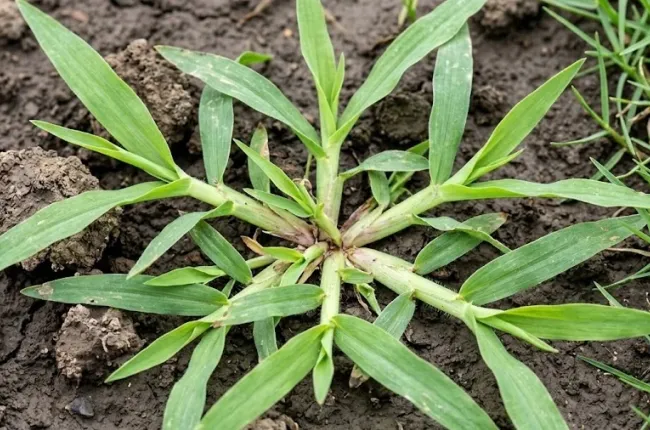
Crabgrass is the weed that drives the entire pre-emergent conversation. It germinates in early April across West Tennessee and Missouri when soil temperature holds at 55°F for several consecutive days. By mid-summer, a single crabgrass plant can produce thousands of seeds that will germinate again next spring.
Identification is straightforward. Crabgrass seedlings grow in a star or rosette pattern from a central point, spreading outward close to the ground. Leaves are coarse, light green, and wider than your turf grass. Unlike Bermuda or Zoysia, crabgrass tillers spread horizontally before bolting upright to flower. Once you see the seed head (a three-pronged fingerlike cluster), it's too late to prevent seeds from falling.
UT Extension and MU Extension both recommend the same timing: "Apply pre-emergent herbicide when soil temperature averages 55°F at a 2-inch depth for several consecutive days" (University of Tennessee Extension, PB 1903). Forsythia bloom provides a visual cue. If you miss the window and crabgrass is already emerging, post-emergent applications become expensive and less effective.
Nutsedge: The Difficult Creeper
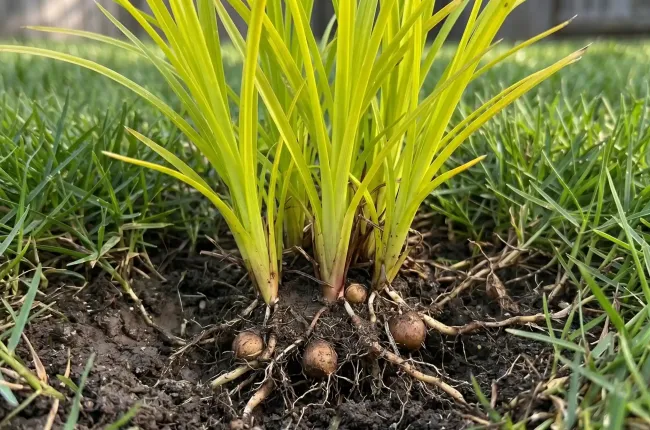
Nutsedge looks nothing like grass, yet homeowners often mistake it for a weed to ignore until summer. The plant has triangular stems and bright yellow-green, glossy leaves that grow in clumps. It spreads through underground tubers (also called nutlets) and grows vigorously in warm, moist soil.
The dangerous thing about nutsedge is that it thrives in the exact conditions that make your warm-season lawn happy: heat and moisture. Nutsedge also grows faster and taller than Bermuda or Zoysia, so it stands out in mid-summer like a lighthouse. By then, the tubers have already multiplied underground.
Pre-emergent does not reliably stop nutsedge since it spreads mostly by tubers, not seed. Instead, you need post-emergent applications once the plant is actively growing, typically June through August. Multiple applications are often necessary since new shoots keep emerging from the tuber network. This is where professional treatment pays off.
Henbit: The Winter Annual That Blooms in Spring
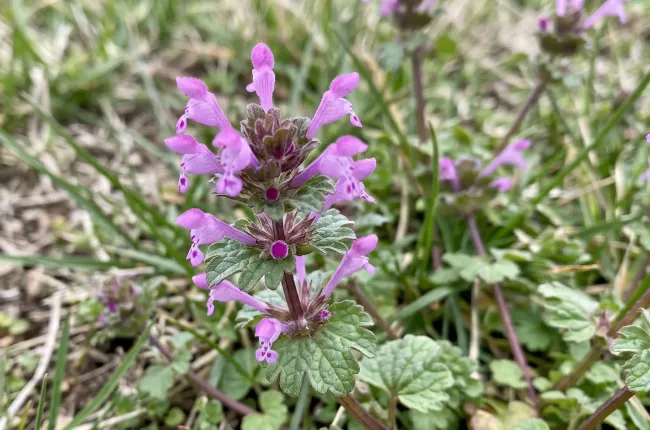
Henbit is a winter annual broadleaf weed that germinates in fall, grows quietly through winter, and flowers in late February through April before dying back in summer heat. It's identifiable by square stems, opposite rounded leaves with scalloped edges, and small pink to purple tubular flowers clustered along the stem.
Henbit thrives in rich, fertile soil. West Tennessee clay soils are perfect for it. The weed is particularly aggressive in thin or stressed turf where competition from dense grass is low. Unlike crabgrass, henbit is a broadleaf and can be controlled with post-emergent broadleaf herbicides once it's visible in early spring. The better move is fall pre-emergent in September before seeds germinate, stopping henbit before it establishes.
Foxtail: Three Species, Same Problem
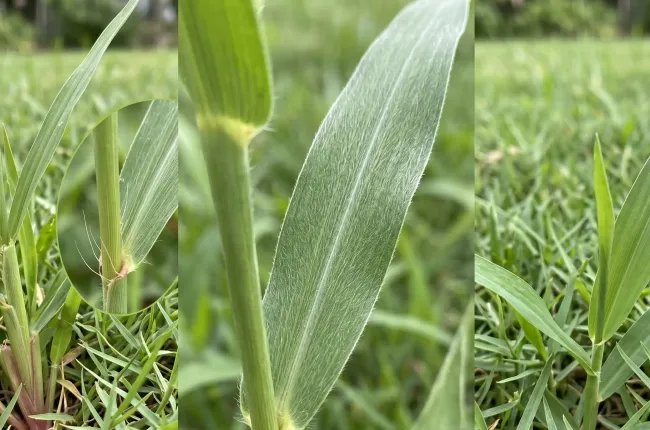
Missouri Extension identifies three common foxtails: giant foxtail, yellow foxtail, and green foxtail. All are summer annual grasses that germinate in warm soil and grow aggressively through July and August. They look like grass, which makes them easy to ignore until they flower and set seed.
The easiest way to tell foxtails from your Bermuda or Zoysia is the leaf blade texture. Yellow foxtail has sparse hairs on the upper surface and flat, distinctive stems. Giant foxtail has a dense hairy upper surface. Green foxtail is smooth. In mid-summer when they flower, the distinctive seed head is unmistakable: a narrow, fingerlike cluster that drops seed easily.
Like crabgrass, foxtail control starts with pre-emergent applied at the 55°F soil temperature mark. Once foxtail is actively growing, post-emergent grassy weed herbicides become necessary, but prevention is always more effective than rescue.
Pre-Emergent Timing Across Both States
Here's where West Tennessee and Missouri align perfectly. Both regions follow the same spring soil temperature schedule. According to both UT Extension and MU Extension, the trigger is consistent: 55°F at a 2-inch soil depth for several consecutive days. Forsythia bloom provides the visual signal in mid-to-late March across both states.
Apply your first spring pre-emergent when soil hits that threshold. A second application 6 to 8 weeks later extends protection through early summer. This two-application program is the industry standard for warm-season lawns in both Tennessee and Missouri.
For henbit and winter annuals, the timing flips. Fall applications in September prevent germination before winter dormancy. Spring applications are less effective because henbit already germinates and grows through fall and winter.
Active Identification in Your Yard
The best time to scout for weeds is when your lawn is actively growing and weeds are visible but still young. In spring, walk your lawn in mid-March and again in mid-April. Look for rosette patterns (crabgrass), triangular-stemmed clumps (nutsedge), square stems with pink flowers (henbit), and hairy leaf blades (foxtail). Early detection makes control easier.
If you find crabgrass seedlings, it means pre-emergent didn't get applied or the window was missed. If you find established nutsedge clumps in June, you're looking at a multi-year management commitment. If henbit is flowering in March, fall pre-emergent next year is the lesson.
When to Call a Professional
Weed identification can be tricky in the early stages. Foxtail seedlings look like grass. Nutsedge shoots can be confused for sedge growth in wet areas. Henbit in dense mats is easy to spot, but isolated plants in thin turf take experience to catch. If you're unsure what you're looking at, a professional scout saves mistakes. Our pre-emergent and herbicide treatments are timed to soil temperature and matched to the specific weeds in your lawn, not just guesswork from a calendar.
Across the region, the same warm-season principles apply. Different weeds have different triggers, but the 55°F threshold and the forsythia bloom are universal signals. Miss it once and you spend the season fighting. Get it right and your lawn stays clean.
Next: Complete Your Spring Strategy
Weed identification and pre-emergent timing are the foundation. Once you know which weeds you're facing and when to apply, you're ready to build a complete spring program. Check out our complete spring lawn care guide for Bermuda and Zoysia to round out your approach with fertilization and aeration timing.
4-Evergreen Lawn Care serves West Tennessee and the Missouri Bootheel with the same weed management expertise. Call us at 731-264-0088 or request a free quote for pre-emergent and weed control timing in your area.
Sources
- University of Tennessee Extension. "2025 Lawn Maintenance Calendar." PB 1903. UT Institute of Agriculture, January 2025, uthort.tennessee.edu/wp-content/uploads/sites/228/2025/01/PB1903-2025.pdf.
- University of Missouri Extension. "Cool-Season Grasses: Lawn Maintenance Calendar." G6705. MU Extension Publications, extension.missouri.edu/publications/g6705.
- Fishel, Fred S., and Kevin W. Bradley. "Identifying Grass Seedlings." IPM1024. University of Missouri Extension, Division of Plant Sciences, extension.missouri.edu/media/wysiwyg/Extensiondata/Pub/pdf/agguides/pests/ipm1024.pdf.